What Was the First Pioneering Movement in Art in Our Century Created by Henri Matisse?

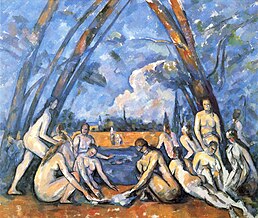
Modern art includes artistic work produced during the flow extending roughly from the 1860s to the 1970s, and denotes the styles and philosophies of the art produced during that era.[1] The term is normally associated with art in which the traditions of the past accept been thrown aside in a spirit of experimentation.[2] Modernistic artists experimented with new ways of seeing and with fresh ideas nigh the nature of materials and functions of fine art. A trend away from the narrative, which was feature for the traditional arts, toward brainchild is characteristic of much modern art. More recent creative production is ofttimes called contemporary art or postmodern art.
Modernistic fine art begins with the heritage of painters like Vincent van Gogh, Paul Cézanne, Paul Gauguin, Georges Seurat and Henri de Toulouse-Lautrec all of whom were essential for the development of modernistic art. At the get-go of the 20th century Henri Matisse and several other young artists including the pre-cubists Georges Braque, André Derain, Raoul Dufy, Jean Metzinger and Maurice de Vlaminck revolutionized the Paris art world with "wild", multi-colored, expressive landscapes and figure paintings that the critics called Fauvism. Matisse's two versions of The Dance signified a cardinal point in his career and in the evolution of mod painting.[3] It reflected Matisse's incipient fascination with primitive art: the intense warm color of the figures against the absurd blue-green background and the rhythmical succession of the dancing nudes convey the feelings of emotional liberation and hedonism.
At the beginning of 20th-century Western painting, and initially influenced by Toulouse-Lautrec, Gauguin and other tardily-19th-century innovators, Pablo Picasso made his start Cubist paintings based on Cézanne's idea that all depiction of nature tin be reduced to 3 solids: cube, sphere and cone. With the painting Les Demoiselles d'Avignon (1907), Picasso dramatically created a new and radical picture depicting a raw and primitive brothel scene with v prostitutes, violently painted women, reminiscent of African tribal masks and his ain new Cubist inventions. Analytic cubism was jointly developed past Picasso and Georges Braque, exemplified by Violin and Candlestick, Paris, from nigh 1908 through 1912. Analytic cubism, the first articulate manifestation of cubism, was followed by Synthetic cubism, expert by Braque, Picasso, Fernand Léger, Juan Gris, Albert Gleizes, Marcel Duchamp and several other artists into the 1920s. Constructed cubism is characterized by the introduction of different textures, surfaces, collage elements, papier collé and a big variety of merged subject affair.[4] [five]
The notion of mod art is closely related to modernism.[a]
History [edit]

Roots in the 19th century [edit]
Although modern sculpture and architecture are reckoned to have emerged at the end of the 19th century, the beginnings of modern painting can be located earlier.[7] The date perhaps almost unremarkably identified as marking the birth of mod art is 1863,[seven] the year that Édouard Manet showed his painting Le déjeuner sur l'herbe in the Salon des Refusés in Paris. Before dates have also been proposed, amidst them 1855 (the year Gustave Courbet exhibited The Creative person's Studio) and 1784 (the year Jacques-Louis David completed his painting The Oath of the Horatii).[seven] In the words of art historian H. Harvard Arnason: "Each of these dates has significance for the development of modern art, but none categorically marks a completely new beginning .... A gradual metamorphosis took identify in the form of a hundred years."[7]
The strands of idea that eventually led to modern art can be traced dorsum to the Enlightenment.[b] The of import modern art critic Cloudless Greenberg, for example, called Immanuel Kant "the first real Modernist" but also drew a stardom: "The Enlightenment criticized from the outside ... . Modernism criticizes from the inside."[9] The French Revolution of 1789 uprooted assumptions and institutions that had for centuries been accepted with footling question and accustomed the public to vigorous political and social debate. This gave ascension to what fine art historian Ernst Gombrich called a "self-consciousness that made people select the style of their building as one selects the pattern of a wallpaper."[10]
The pioneers of modern art were Romantics, Realists and Impressionists.[11] [ failed verification ] By the belatedly 19th century, boosted movements which were to be influential in modern art had begun to sally: post-Impressionism and Symbolism.
Influences upon these movements were varied: from exposure to Eastern decorative arts, particularly Japanese printmaking, to the coloristic innovations of Turner and Delacroix, to a search for more realism in the depiction of common life, as institute in the work of painters such equally Jean-François Millet. The advocates of realism stood confronting the idealism of the tradition-bound academic art that enjoyed public and official favor.[12] The near successful painters of the day worked either through commissions or through large public exhibitions of their own work. There were official, government-sponsored painters' unions, while governments regularly held public exhibitions of new fine and decorative arts.
The Impressionists argued that people do not see objects merely but the light which they reverberate, and therefore painters should paint in natural light (en plein air) rather than in studios and should capture the effects of light in their work.[13] Impressionist artists formed a group, Société Anonyme Coopérative des Artistes Peintres, Sculpteurs, Graveurs ("Association of Painters, Sculptors, and Engravers") which, despite internal tensions, mounted a serial of independent exhibitions.[14] The style was adopted past artists in different nations, in preference to a "national" style. These factors established the view that it was a "movement". These traits—institution of a working method integral to the art, establishment of a motility or visible active core of back up, and international adoption—would be repeated by artistic movements in the Modern menstruation in art.
Early 20th century [edit]
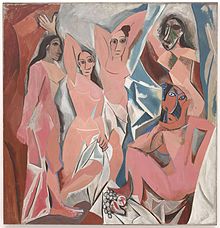
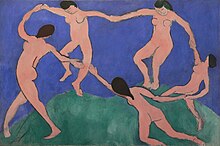
Among the movements which flowered in the offset decade of the 20th century were Fauvism, Cubism, Expressionism, and Futurism.
During the years betwixt 1910 and the end of World War I and later on the heyday of cubism, several movements emerged in Paris. Giorgio de Chirico moved to Paris in July 1911, where he joined his brother Andrea (the poet and painter known as Alberto Savinio). Through his brother he met Pierre Laprade, a member of the jury at the Salon d'Automne where he exhibited 3 of his dreamlike works: Enigma of the Oracle, Enigma of an Afternoon and Self-Portrait. During 1913 he exhibited his work at the Salon des Indépendants and Salon d'Automne, and his work was noticed by Pablo Picasso, Guillaume Apollinaire, and several others. His compelling and mysterious paintings are considered instrumental to the early beginnings of Surrealism. Vocal of Love (1914) is i of the most famous works past de Chirico and is an early example of the surrealist way, though it was painted 10 years before the movement was "founded" by André Breton in 1924.
World State of war I brought an end to this phase but indicated the get-go of a number of anti-art movements, such every bit Dada, including the work of Marcel Duchamp, and of Surrealism. Artist groups similar de Stijl and Bauhaus developed new ideas near the interrelation of the arts, compages, design, and art education.
Modernistic art was introduced to the The states with the Armory Show in 1913 and through European artists who moved to the U.South. during Globe War I.
After World War 2 [edit]
It was just afterwards World War Two, however, that the U.S. became the focal signal of new artistic movements.[fifteen] The 1950s and 1960s saw the emergence of Abstract Expressionism, Color field painting, Conceptual artists of Art & Language, Pop art, Op art, Hard-edge painting, Minimal fine art, Lyrical Abstraction, Fluxus, Happening, Video art, Postminimalism, Photorealism and various other movements. In the late 1960s and the 1970s, Country art, Operation art, Conceptual art, and other new art forms had attracted the attention of curators and critics, at the expense of more traditional media.[16] Larger installations and performances became widespread.
By the end of the 1970s, when cultural critics began speaking of "the finish of painting" (the title of a provocative essay written in 1981 by Douglas Crimp), new media art had become a category in itself, with a growing number of artists experimenting with technological means such as video fine art.[17] Painting causeless renewed importance in the 1980s and 1990s, as evidenced by the rise of neo-expressionism and the revival of figurative painting.[xviii]
Towards the end of the 20th century, a number of artists and architects started questioning the idea of "the modern" and created typically Postmodern works.[xix]
Fine art movements and creative person groups [edit]
(Roughly chronological with representative artists listed.)
19th century [edit]
- Romanticism and the Romantic movement – Francisco de Goya, J. M. Due west. Turner, Eugène Delacroix
- Realism – Gustave Courbet, Camille Corot, Jean-François Millet, Rosa Bonheur
- Pre-Raphaelites – William Holman Hunt, John Everett Millais, Dante Gabriel Rossetti
- Macchiaioli – Giovanni Fattori, Silvestro Lega, Telemaco Signorini
- Impressionism – Frédéric Bazille, Gustave Caillebotte, Mary Cassatt, Edgar Degas, Armand Guillaumin, Édouard Manet, Claude Monet, Berthe Morisot, Pierre-Auguste Renoir, Camille Pissarro, Alfred Sisley
- Mail-impressionism – Georges Seurat, Paul Cézanne, Paul Gauguin, Vincent van Gogh, Henri de Toulouse-Lautrec, Henri Rousseau, Henri-Jean Guillaume Martin, Albert Lebourg, Robert Antoine Pinchon
- Pointillism – Georges Seurat, Paul Signac, Maximilien Luce, Henri-Edmond Cross
- Divisionism – Gaetano Previati, Giovanni Segantini, Pellizza da Volpedo
- Symbolism – Gustave Moreau, Odilon Redon, Edvard Munch, James Whistler, James Ensor
- Les Nabis – Pierre Bonnard, Édouard Vuillard, Félix Vallotton, Maurice Denis, Paul Sérusier
- Art Nouveau and variants – Jugendstil, Secession, Modern Style, Modernisme – Aubrey Beardsley, Alphonse Mucha, Gustav Klimt,
- Art Nouveau compages and design – Antoni Gaudí, Otto Wagner, Wiener Werkstätte, Josef Hoffmann, Adolf Loos, Koloman Moser
- Early Modernist sculptors – Aristide Maillol, Auguste Rodin
Early on 20th century (earlier Earth State of war I) [edit]
- Abstract art – Francis Picabia, Wassily Kandinsky, František Kupka, Robert Delaunay, Sonia Delaunay, Léopold Survage, Piet Mondrian, Kazimir Malevich, Hilma af Klint
- Fauvism – André Derain, Henri Matisse, Maurice de Vlaminck, Georges Braque, Kees van Dongen
- Expressionism and related – Dice Brücke, Der Blaue Reiter – Ernst Ludwig Kirchner, Wassily Kandinsky, Franz Marc, Egon Schiele, Oskar Kokoschka, Emil Nolde, Axel Törneman, Karl Schmidt-Rottluff, Max Pechstein
- Cubism – Pablo Picasso, Georges Braque, Jean Metzinger, Albert Gleizes, Fernand Léger, Robert Delaunay, Henri Le Fauconnier, Marcel Duchamp, Jacques Villon, Francis Picabia, Juan Gris
- Futurism – Giacomo Balla, Umberto Boccioni, Carlo Carrà, Gino Severini, Natalia Goncharova, Mikhail Larionov
- Orphism – Robert Delaunay, Sonia Delaunay, František Kupka
- Suprematism – Kazimir Malevich, Alexander Rodchenko, El Lissitzky
- Synchromism – Stanton Macdonald-Wright, Morgan Russell
- Vorticism – Wyndham Lewis
- Sculpture – Constantin Brâncuși, Joseph Csaky, Alexander Archipenko, Raymond Duchamp-Villon, Jacques Lipchitz, Ossip Zadkine, Henri Laurens, Elie Nadelman, Chaim Gross, Chana Orloff, Jacob Epstein, Gustave Miklos
- Photography – Pictorialism, Directly photography
Earth War I to World War Two [edit]
- Dada – Jean Arp, Marcel Duchamp, Max Ernst, Francis Picabia, Kurt Schwitters
- Surrealism – Marc Chagall, René Magritte, Jean Arp, Salvador Dalí, Max Ernst, Giorgio de Chirico, André Masson, Joan Miró
- Expressionism and related: Chaim Soutine, Abraham Mintchine
- Pittura Metafisica – Giorgio de Chirico, Carlo Carrà, Giorgio Morandi
- De Stijl – Theo van Doesburg, Piet Mondrian
- New Objectivity – Max Beckmann, Otto Dix, George Grosz
- Figurative painting – Henri Matisse, Pierre Bonnard
- American Modernism – Stuart Davis, Arthur G. Pigeon, Marsden Hartley, Georgia O'Keeffe
- Constructivism – Naum Gabo, Gustav Klutsis, László Moholy-Nagy, El Lissitzky, Kasimir Malevich, Vadim Meller, Alexander Rodchenko, Vladimir Tatlin
- Bauhaus – Wassily Kandinsky, Paul Klee, Josef Albers
- Scottish Colourists – Francis Cadell, Samuel Peploe, Leslie Hunter, John Duncan Fergusson
- Social realism – Grant Wood, Walker Evans, Diego Rivera
- Precisionism – Charles Sheeler, Charles Demuth
- Boychukism - Mykhailo Boychuk, Sofiya Nalepinska-Boychuk, Ivan Padalka, Vasily Sedlyar
- Sculpture – Alexander Calder, Alberto Giacometti, Gaston Lachaise, Henry Moore, Pablo Picasso, Julio Gonzalez
After Earth War II [edit]
- Figuratifs – Bernard Buffet, Jean Carzou, Maurice Boitel, Daniel du Janerand, Claude-Max Lochu
- Sculpture – Henry Moore, David Smith, Tony Smith, Alexander Calder, Isamu Noguchi,[twenty] Alberto Giacometti, Sir Anthony Caro, Jean Dubuffet, Isaac Witkin, René Iché, Marino Marini, Louise Nevelson, Albert Vrana
- Abstract expressionism – Joan Mitchell, Willem de Kooning, Jackson Pollock, Arshile Gorky, Hans Hofmann, Franz Kline, Robert Motherwell, Clyfford Still, Lee Krasner,
- American Abstruse Artists – Ilya Bolotowsky, Ibram Lassaw, Advertisement Reinhardt, Josef Albers, Burgoyne Diller
- Art Brut – Adolf Wölfli, August Natterer, Ferdinand Cheval, Madge Gill
- Arte Povera – Jannis Kounellis, Luciano Fabro, Mario Merz, Piero Manzoni, Alighiero Boetti
- Color field painting – Barnett Newman, Marking Rothko, Adolph Gottlieb, Sam Francis, Morris Louis, Kenneth Noland, Jules Olitski, Helen Frankenthaler
- Tachisme – Jean Dubuffet, Pierre Soulages, Hans Hartung, Ludwig Merwart
- COBRA – Pierre Alechinsky, Karel Appel, Asger Jorn
- Conceptual art – Art & Linguistic communication, Dan Graham, Lawrence Weiner, Bruce Nauman, Daniel Buren, Victor Burgin, Sol LeWitt
- De-collage – Wolf Vostell, Mimmo Rotella
- Neo-Dada – Robert Rauschenberg, Jasper Johns, John Chamberlain, Joseph Beuys, Lee Bontecou, Edward Kienholz
- Figurative Expressionism – Larry Rivers, Grace Hartigan, Elaine de Kooning, Robert De Niro, Sr., Lester Johnson, George McNeil, Earle M. Pilgrim, Jan Müller, Robert Beauchamp, Bob Thompson
- Feminist Fine art — Eva Hesse, Judy Chicago, Barbara Kruger, Mary Beth Edelson, Ewa Partum, Valie Export, Yoko Ono, Louise Conservative, Cindy Sherman, Kiki Smith, Guerrilla Girls, Hannah Wilke
- Fluxus – George Maciunas, Joseph Beuys, Wolf Vostell, Nam June Paik, Daniel Spoerri, Dieter Roth, Carolee Schneeman, Alison Knowles, Charlotte Moorman, Dick Higgins
- Happening – Allan Kaprow, Joseph Beuys, Wolf Vostell, Claes Oldenburg, Jim Dine, Cherry-red Grooms, Nam June Paik, Charlotte Moorman, Robert Whitman, Yoko Ono
- Dau-al-Set up – founded in Barcelona by poet/artist Joan Brossa, – Antoni Tàpies
- Grupo El Paso – founded in Madrid by artists Antonio Saura, Pablo Serrano
- Geometric abstraction – Wassily Kandinsky, Kazimir Malevich, Nadir Afonso, Manlio Rho, Mario Radice, Mino Argento, Adam Szentpétery
- Hard-edge painting – John McLaughlin, Ellsworth Kelly, Frank Stella, Al Held, Ronald Davis
- Kinetic art – George Rickey, Getulio Alviani
- State art – Ana Mendieta, Christo, Richard Long, Robert Smithson, Michael Heizer
- Les Automatistes – Claude Gauvreau, Jean-Paul Riopelle, Pierre Gauvreau, Fernand Leduc, Jean-Paul Mousseau, Marcelle Ferron
- Minimal art – Sol LeWitt, Donald Judd, Dan Flavin, Richard Serra, Agnes Martin
- Postminimalism – Eva Hesse, Bruce Nauman, Lynda Benglis
- Lyrical abstraction – Ronnie Landfield, Sam Gilliam, Larry Zox, Dan Christensen, Natvar Bhavsar, Larry Poons
- Neo-figurative art – Fernando Botero, Antonio Berni
- Neo-expressionism – Georg Baselitz, Anselm Kiefer, Jörg Immendorff, Jean-Michel Basquiat
- Transavanguardia – Francesco Clemente, Mimmo Paladino, Sandro Chia, Enzo Cucchi
- Figuration libre – Hervé Di Rosa, François Boisrond, Robert Combas
- New realism – Yves Klein, Pierre Restany, Arman
- Op art – Victor Vasarely, Bridget Riley, Richard Anuszkiewicz, Jeffrey Steele
- Outsider art – Howard Finster, Grandma Moses, Bob Justin
- Photorealism – Audrey Flack, Chuck Shut, Duane Hanson, Richard Estes, Malcolm Morley
- Pop art – Richard Hamilton, Robert Indiana, Jasper Johns, Roy Lichtenstein, Robert Rauschenberg, Andy Warhol, Ed Ruscha, David Hockney
- Postwar European figurative painting – Lucian Freud, Francis Bacon, Frank Auerbach, Gerhard Richter
- New European Painting – Luc Tuymans, Marlene Dumas, Neo Rauch, Bracha Ettinger, Michaël Borremans, Chris Ofili
- Shaped sail – Frank Stella, Kenneth Noland, Ron Davis, Robert Mangold.
- Soviet art – Aleksandr Deyneka, Aleksandr Gerasimov, Ilya Kabakov, Komar & Melamid, Alexandr Zhdanov, Leonid Sokov
- Spatialism – Lucio Fontana
- Video art – Nam June Paik, Wolf Vostell, Joseph Beuys, Nib Viola, Hans Breder
- Visionary art – Ernst Fuchs, Paul Laffoley, Michael Bowen
Notable modernistic fine art exhibitions and museums [edit]
Austria [edit]
- Leopold Museum, Vienna
Belgium [edit]
- SMAK, Ghent
Brazil [edit]
- MASP, São Paulo, SP
- MAM/SP, São Paulo, SP
- MAM/RJ, Rio de Janeiro, RJ
- MAM/BA, Salvador, Bahia
Colombia [edit]
- Bogotá Museum of Mod Art (MAMBO)
Republic of croatia [edit]
- Ivan Meštrović Gallery, Dissever
- Modern Gallery, Zagreb
- Museum of Contemporary Art, Zagreb
Ecuador [edit]
- Museo Antropologico y de Arte Contemporaneo, Guayaquil
- La Capilla del Hombre, Quito
Republic of finland [edit]
- EMMA, Espoo
- Kiasma, Helsinki
French republic [edit]
- Château de Montsoreau-Museum of Gimmicky Art, Montsoreau
- Lille Métropole Museum of Modern, Contemporary and Outsider Fine art, Villeneuve d'Ascq
- Musée d'Orsay, Paris
- Musée d'Art Moderne de la Ville de Paris, Paris
- Musée National d'Fine art Moderne, Paris
- Musée Picasso, Paris
- Museum of Modern and Contemporary Fine art, Strasbourg
- Musée d'fine art moderne de Troyes
Germany [edit]
- documenta, Kassel, an exhibition of modern and gimmicky art held every five years
- Museum Ludwig, Cologne
- Pinakothek der Moderne, Munich
India [edit]
- Eye of International Modern Fine art (CIMA),[21] Kolkata
- National Gallery of Modern Fine art, New Delhi
- National Gallery of Mod Art, Mumbai
- National Gallery of Modern Art, Bangalore
Iran [edit]
- Museum of Gimmicky Art, Tehran
Republic of ireland [edit]
- Hugh Lane Gallery, Dublin
- Irish gaelic Museum of Modern Art, Dublin
Israel [edit]
- Tel Aviv Museum of Art
Italia [edit]
- Palazzo delle Esposizioni
- Galleria Nazionale d'Arte Moderna
- Venice Biennial, Venice
- Palazzo Pitti, Florence
- Museo del Novecento, Milan
Mexico [edit]
- Museo de Arte Moderno, México D.F.
Netherlands [edit]
- Van Gogh Museum, Amsterdam
- Stedelijk Museum, Amsterdam
Kingdom of norway [edit]
- Astrup Fearnley Museum of Modern Art, Oslo
- Henie-Onstad Art Centre, Oslo
Poland [edit]
- Museum of Fine art, Łódź
- National Museum, Kraków
Qatar [edit]
- Mathaf: Arab Museum of Modern Fine art, Doha
Romania [edit]
- National Museum of Contemporary Art, Bucharest
Russian federation [edit]
- Hermitage Museum, Saint Petersburg
- Pushkin Museum, Moscow
- Tretyakov Gallery, Moscow
Serbia [edit]
- Museum of Gimmicky Art, Belgrade
Spain [edit]
- Museu d'Art Contemporani de Barcelona, Barcelona
- Museo Nacional Centro de Arte Reina Sofía, Madrid
- Thyssen-Bornemisza Museum, Madrid
- Institut Valencià d'Art Modern, Valencia
- Atlantic Center of Mod Art, Las Palmas de Gran Canaria
- Museu Picasso, Barcelona.
- Museo Picasso Málaga, Málaga.
Sweden [edit]
- Moderna Museet, Stockholm
Taiwan [edit]
- Asia Museum of Modern Art, Taichung
Uk [edit]
- Estorick Collection of Modern Italian Art, London
- Saatchi Gallery, London
- Tate Britain, London
- Tate Liverpool
- Tate Modernistic, London
- Tate St Ives
Ukraine [edit]
- National Fine art Museum of Ukraine, Kyiv
- Andrey Sheptytsky National Museum of Lviv, Lviv
United states [edit]
- Albright-Knox Art Gallery, Buffalo, New York
- Art Institute of Chicago, Chicago, Illinois
- Governor Nelson A. Rockefeller Empire State Plaza Fine art Collection, Albany, New York
- Guggenheim Museum, New York Urban center, New York, and Venice, Italy ; more than recently in Berlin, Germany, Bilbao, Spain, and Las Vegas, Nevada
- High Museum, Atlanta, Georgia
- Los Angeles County Museum of Fine art, Los Angeles, California
- McNay Art Museum, San Antonio, Texas
- Menil Collection, Houston, Texas
- Museum of Fine Arts, Boston, Massachusetts
- Museum of Mod Fine art, New York City, New York
- San Francisco Museum of Modern Art, San Francisco, California
- The Baker Museum, Naples, Florida
- Walker Art Heart, Minneapolis, Minnesota
- Whitney Museum of American Fine art, New York City, New York
See also [edit]
- 20th century art
- 20th-century Western painting
- Art manifesto
- Art movements
- Art periods
- Conceptual art
- Contemporary art
- Gesamtkunstwerk
- History of painting
- List of 20th-century women artists
- List of modernistic artists
- Mod architecture
- Modernism
- Postmodern art
- Western painting
Notes [edit]
- ^ "1 way of understanding the relation of the terms 'modern,' 'modernity,' and 'modernism' is that artful modernism is a class of art characteristic of loftier or actualized tardily modernity, that is, of that period in which social, economical, and cultural life in the widest sense [was] revolutionized by modernity ... [this means] that modernist fine art is scarcely thinkable exterior the context of the modernized society of the belatedly nineteenth and twentieth centuries. Social modernity is the home of modernist art, fifty-fifty where that fine art rebels against it." — Lawrence E. Cahoone[6]
- ^ "In the seventeenth and eighteenth centuries momentum began to gather behind a new view of the world, which would eventually create a new world, the modern world." — Lawrence East. Cahoone[eight]
References [edit]
- ^ Atkins 1997, pp. 118–119.
- ^ Gombrich 1995, p. 557.
- ^ Clement 1996, p. 114.
- ^ Scobie 1988, pp. 103–107.
- ^ John-Steiner 2006, p. 69.
- ^ Cahoone 1996, p. 13.
- ^ a b c d Arnason & Prather 1998, p. 17.
- ^ Cahoone 1996, p. 27.
- ^ Greenberg 1982, p. 5.
- ^ Gombrich 1995, p. 477.
- ^ Arnason & Prather 1998, p. 22.
- ^ Corinth et al. 1996, p. 25.
- ^ Cogniat 1975, p. 61.
- ^ Cogniat 1975, pp. 43–49.
- ^ Saunders 2013.
- ^ Mullins 2006, p. xiv.
- ^ Mullins 2006, p. ix.
- ^ Mullins 2006, pp. 14–15.
- ^ Jencks 1987, p.[ page needed ].
- ^ Lander 2006.
- ^ Times of India Travel 2015.
Sources [edit]
- Arnason, H. Harvard; Prather, Marla (1998). History of modern art : painting, sculpture, architecture, photography (4th ed.). New York: Harry N. Abrams, Inc. ISBN978-0-8109-3439-9. OCLC 1035593323 – via Cyberspace Annal.
- Atkins, Robert (1997). Artspeak: A Guide to Gimmicky Ideas, Movements, and Buzzwords (2d ed.). New York: Abbeville Press Publishers. ISBN978-0-7892-0415-8. OCLC 605278894 – via Cyberspace Archive.
- Cahoone, Lawrence (1996). From Modernism to Postmodernism: An Anthology . Cambridge, Mass: Blackwell Publishers. ISBN978-one-55786-602-8. OCLC 1149327777 – via Internet Annal.
- "CIMA Art Gallery". Times of India Travel. 2015-06-30. Retrieved 2021-06-12 .
- Clement, Russell (1996). Four French Symbolists: A Sourcebook on Pierre Puvis de Chavannes, Gustave Moreau, Odilon Redon, and Maurice Denis. Westport, Conn: Greenwood Printing. ISBN978-0-313-29752-vi. OCLC 34191505.
- Cogniat, Raymond (1975). Pissarro. New York: Crown Publishers. ISBN978-0-517-52477-0. OCLC 2082821.
- Corinth, Lovis; Schuster, Peter-Klaus; Vitali, Christoph; Butts, Barbara; Brauner, Lothar; Bärnreuther, Andrea (1996). Lovis Corinth. Munich; New York: Prestel. ISBN978-3-7913-1682-6. OCLC 35280519.
- Greenberg, Clement (1982). "Modernist Painting". In Frascina, Francis; Harrison, Charles; Paul, Deirdre (eds.). Modern Art and Modernism: A Critical Album . In association with the Open University. London: Harper & Row. ISBN978-0-06-318234-9. OCLC 297414909 – via Net Archive.
- Gombrich, Ernst H. (1995). The Story of Art . London: Phaidon Press Limited. ISBN978-0-7148-3355-two. OCLC 1151352542 – via Internet Annal.
- Jencks, Charles (1987). Post-Modernism: The New Classicism in Art and Compages . New York: Rizzoli. ISBN978-0-8478-0835-9. OCLC 1150952960 – via Inernet Archive.
- John-Steiner, Vera (2006). "Patterns of Collaboration amongst Artists". Creative Collaboration. Oxford Academy Press. pp. 63–96. doi:10.1093/acprof:oso/9780195307702.003.0004. ISBN978-0-19-530770-two. OCLC 5105130725, 252638637.
- Lander, David (November–December 2006). "Fifties Piece of furniture THE SIDE TABLE Every bit SCULPTURE". Shopping. American Heritage. American Association for State and Local History. 57 (half-dozen). ISSN 2161-8496. OCLC 60622066. Archived from the original on 2007-x-20.
- Mullins, Charlotte (2006). Painting people : figure painting today. New York: D.A.P./Distributed Art Pubs. ISBN978-1-933045-38-2. OCLC 71679906.
- Saunders, Frances Stonor (2013-06-xiv) [1995-10-22]. "Modern fine art was CIA 'weapon'". The Independent . Retrieved 2021-04-17 .
- Scobie, Stephen (1988). "The Allure of Multiplicity: Metaphor and Metonymy in Cubism and Gertrude Stein". In Neuman, Due south. C.; Nadel, Ira Bruce (eds.). Gertrude Stein and the Making of Literature. London: Palgrave Macmillan UK. doi:10.1007/978-1-349-08541-5_7. ISBN978-1-349-08543-ix. OCLC 7323640453 – via Cyberspace Archive.
Farther reading [edit]
- Adams, Hugh (1979). Modern Painting . New York: Mayflower Books. ISBN978-0-8317-6062-5. OCLC 691113035 – via Cyberspace Archive.
- Childs, Peter (2000). Modernism . London New York: Routledge. ISBN978-0-203-13116-nine. OCLC 48138104 – via Internet Archive.
- Crouch, Christopher (1999). Modernism in Art, Blueprint and Compages . New York: St. Martin'southward Printing. ISBN978-0-312-21830-0. OCLC 1036752206 – via Internet Annal.
- Dempsey, Amy (2002). Art in the Modern Era: A Guide to Schools and Movements. New York: Harry Due north. Abrams. ISBN978-0-8109-4172-four. OCLC 47623954.
- Everdell, William (1997). The Beginning Moderns: Profiles in the Origins of Twentieth-Century Thought . Chicago: University of Chicago Press. ISBN978-0-226-22484-eight. OCLC 45733213 – via Internet Annal.
Meet too: The First Moderns. - Frazier, Nancy (2000). The Penguin Concise Dictionary of Art History. New York: Penguin Reference. ISBN978-0-14-051420-9. OCLC 70498418.
- Hunter, Sam; Jacobus, John M; Wheeler, Daniel (2005). Modern Art: painting, sculpture, architecture, photography (tertiary ed.). Upper Saddle River, NJ: Prentice Hall. ISBN978-0-13-150519-3. OCLC 1114759321.
- Kolocotroni, Vassiliki; Goldman, Jane; Taxidou, Olga, eds. (1998). Modernism: An Anthology of Sources and Documents . Edinburgh; Chicago: Edinburgh University Press; The University of Chicago Press. ISBN978-0-585-19313-7. OCLC 1150833644, 44964346 – via Cyberspace Annal.
- Ozenfant, Amédée; Rodker, John (1952). Foundations of Modern Art . New York: Dover. ISBN9780486202150. OCLC 1200478998. Retrieved 2021-04-19 – via Internet Archive.
- Read, Herbert Edward; Read, Benedict; Tisdall, Caroline; Feaver, William (1975). A Curtailed History of Modern Painting . New York: Praeger Publishers. ISBN978-0-275-71730-8. OCLC 741987800, 894774214, 563965849 – via Internet Archive.
External links [edit]
 | Wikimedia Commons has media related to Mod art. |
- Tate Mod
- The Museum of Modern Art
- Modernistic artists and fine art
- A TIME Archives Drove of Mod Fine art'southward perception
- National Gallery of Mod Art – Govt. of India
Source: https://en.wikipedia.org/wiki/Modern_art
0 Response to "What Was the First Pioneering Movement in Art in Our Century Created by Henri Matisse?"
Post a Comment