Do I Need to Know How to Draw to Be an Art Professor
What follows in this mail service is informed by my own fine art higher experience – both as an undergraduate student and instructor – forth with several years worth of hindsight. While the country of affairs I describe hither persists at many fine art schools to this day, I'one thousand aware that information technology's not universal. Younger readers, in particular, may have had quite unlike experiences at their respective colleges as the art educational activity landscape changes. I hope that trend continues.
Is it possible to larn how to draw while at an art college?
To the uninitiated, this may sound like a silly question. Out of all the options for learning to draw, a proper fine art higher would seem like a safe bet.
Simply information technology's non that uncomplicated.
Dorsum when I was enrolled in a full-time, four-year undergraduate plan at a legitimate art higher, I struggled to find quality instruction in observational drawing and painting. To my surprise, most of the faculty couldn't draw well themselves. The few capable teachers that I did find were just as frustrated as I was because the powers-that-be – the people who ran the Drawing and Painting Department – merely didn't intendance most representational art. And they got to choose the curriculum.
Unfortunately, my experience isn't an isolated one. I've lost count of how many other representational artists I've spoken with most this over the years. And almost all of them recounted similar experiences with the aforementioned forlorn expression on their faces.
"I think this would look better in four pieces," he said. Then he tore the painting in half, twice, before handing it back to her.
I was balked.
Hither'south how bad it can get: I remember vividly equally 1 of my classmates burst into tears following a disheartening exchange with a full-fourth dimension faculty member at our schoolhouse. In what was mayhap a misguided move on her role, my classmate approached him for advice on a watercolor mural that she had painted. This teacher was notoriously hostile to representational work, merely however, his response was fell.
"I call back this would wait better in four pieces," he said. Then he tore the painting in half, twice, earlier handing it back to her.
I was aghast.
How on earth could this happen? In this post, I'll try to explain the contempo state of representational drawing instruction at most fine art colleges. And so I'll brand a case for why that might exist changing, and how all of this may impact you.
"Art" is a Big Word
First off, as an art teacher myself, I take to say I'chiliad sympathetic to the plight of today's art colleges considering they take a huge responsibility: Teaching "fine art."
In the 21st century, the word "art" has so many definitions and encompasses so many disciplines that trying to include them all into one institution is a herculean task. Equally the fine art globe expands to include new and heady media like 3D video and virtual reality, it's not surprising, I suppose, that something as dusty and "old school" every bit drawing would have a back seat. After all, near schools – even the expensive ones – are working with limited resources, which forces them to prioritize what they teach.
But in that location'south more to it than that.
When compared to land-of-the-art photography facilities or figurer labs, a drawing or painting studio is pretty cheap to maintain. So, it tin't simply exist a matter of limited resource.
To fully understand the recent state of drawing and painting instruction at the college level, it's important to accept a look back at history.
The Ascension of Modernism
Representational art wasn't always equally disrespected as it has been in contempo decades. In fact, it played a cardinal function in western society for millennia.
Dating as far back as aboriginal Egypt (and much farther if nosotros consider pre-historic cave paintings), about representational art was religious or ceremonial in nature. Its goal was to illustrate the stories of myth or scripture.
Illustration of any kind was dismissed every bit quaint and corny – a nostalgic throw-back to simpler times.
The latter half of the 19th century, however, saw a radical shift in the fine art world. Thanks to industrialization, lodge inverse at a rapid pace that was at times heady and also deeply frightening. These changes were so profound that many artists felt they needed an entirely new way of making and thinking about art. As a event, "Modernism" was born.
Modernism rejected representation in art. Illustration of any kind was dismissed every bit quaint and corny – a nostalgic throw-back to simpler times. By the 1960s, brainchild became the default mode of painting.
Just abstract art was more difficult for laypeople to empathize and digest than traditional representational work. In gild to appreciate this kind of art, a knowledge of art theory and criticism is really necessary. Otherwise, it's hard to discover meaning and context. This country of affairs persists today, where much "post-modern" or "contemporary" artwork is inscrutable to all just a relatively small circumvolve of informed insiders.
Art schools were not immune to this shift.
Equally modernism picked up steam, university-level art schools felt increasing pressure to discard traditional ideas and methods to stay relevant. Somewhen, nearly all of them did.
For the past few decades, post-secondary art schools have de-emphasized the importance of educational activity students to depict and paint what they come across. As a event, much of the faculty at art colleges (at least when I was enrolled) were never taught to depict well themselves and couldn't teach their own students to do so – even if they wanted to. Over the years, this led to a brutal cycle where fewer and fewer people taught or learned how to describe.
The Ascension of "Credentialism"
As modernism took concord and began to disrupt academy-affiliated art schools, those that were not connected to a university shortly began to feel a dissimilar kind of pressure.
You see, many art colleges used to be considered "trade schools" that didn't offer degrees. They focused on training. Artists and illustrators weren't expected to emerge from schoolhouse with a B.F.A. Instead, the goal of these trade schools was to provide solid instruction that helped students develop a skill set and a strong portfolio of work.
Following the Second World War, however, the United states experienced a broad societal shift that was initiated by a smash in young people seeking post-secondary educational activity. The resulting overabundance of academy-educated workers drastically changed the labor market. By the 1970s, due to competition from well-educated applicants, professions that once offered good prospects to those without a degree all but required ane. With the concurrent decline in manufacturing jobs, available career options for anyone without a college degree were greatly diminished.
The demand for even more qualifications has led to a curious phenomenon known as "credentialism" or "degree aggrandizement," where employers wait for e'er-higher qualifications for the same jobs.
All of this worked together to make degrees appear more valuable. Past the fourth dimension I was a teenager, applying to academy had become the default expectation for nearly all students that were graduating from high school.
Today, many are inclined to distrust any professional person who doesn't have at least a bachelor'southward caste. In fact, a bachelor'south caste may not be enough. The demand for even more qualifications has led to a curious phenomenon known every bit "credentialism" or "degree inflation," where employers look for ever-higher qualifications for the same jobs.
By the 1990s, independent art schools were feeling the rut. If they wanted to attract quality applicants (and accuse them accordingly) they'd accept to start offering degrees, too. Equally a event, nearly major art colleges have already transitioned exclusively to four-year bachelor's and fifty-fifty master'due south degree programs.
Art Training Isn't Prioritized In Academic Caste Programs
This transition to degree programs brought profound changes to art schoolhouse curricula. Many accrediting regime – the organizations that decide what schools tin can grant degrees – require available's degree programs to be built effectually a core curriculum that is ordinarily academic in nature. In other words, the old "trade school" model that focused on teaching applied skills is no longer sufficient. To comply with these requirements, fine art colleges now make significant academic demands of their students.
Now, don't get me incorrect. This isn't necessarily a bad thing. Core requirements be to ensure students get a wide base of knowledge that helps them become thoughtful, articulate people. Having studied politics and history myself in university, I believe the humanities are important.
Simply for students looking to develop their drawing and painting skills, this kind of schoolhouse work doesn't actually help them meet their goals. The fourth dimension spent writing papers detracts significantly from the time one could spend in the studio.
If observational cartoon and painting skills aren't important anyhow, as the core tenets of modernism suggest, so the sacrifice of studio training is no loss.
And yet, fine art schools are happy to comply. Art theory and criticism now play a key office in the art world. Students seeking to participate in that dialogue need to spend plenty of fourth dimension reading and learning to speak virtually their work in a contemporary critical context. If observational drawing and painting skills aren't important anyway, every bit the cadre tenets of modernism suggest, then the cede of studio preparation is no loss.
And so, this is where we are. Many fine art colleges don't appear to teach traditional drawing and painting skills because:
- Such skills aren't valued at these institutions and oasis't been for decades
- Caste programs emphasize academics, often at the expense of practical training
Things Are Improving
And then what is a would-be representational artist to do? There are plenty of reasons to exist optimistic:
Credentialism May Have Peaked
Recent hiring trends advise that getting a caste isn't the sacred cow it used to be. Big tech companies, like Apple tree and Google, have recently changed their hiring policies to have applicants without post-secondary degrees. They've adamant that top talent doesn't always come from colleges and universities anymore. This would have been unthinkable simply a few years ago.
While I'm no fortune teller, I conceptualize this tendency volition go along and spread to other fields every bit the toll of post-secondary education spirals to absurd heights (at to the lowest degree in the United States). This will no doubt take an impact on art schools. After all, is that B.F.A. actually worth the lifetime of burdensome debt that may come up with it?
In the about future, I believe the frequent answer volition be "no."
There Are Adept Options Outside of Art Higher
Fine art college isn't the simply (or fifty-fifty the best) option for those seeking teaching in representational fine art. Private art studios and "ateliers" accept flourished over the final 20 years because they provide thousands of hungry students what art colleges haven't: solid, skills-based practical preparation in representational drawing and painting.
In fact, some of today's most respected realist painters didn't learn their craft at higher at all, but rather under the guidance of a specific, agreeing artist or group of artists.
Many individual studio schools offer programs of study that are as rigorous and demanding equally most would expect higher to exist, with some even requiring total-time, 4-year commitments. Even so, these schools are unencumbered by the requirements of accrediting authorities and are free to teach their students what they judge to exist important. This model is more than like the trade schools of old.
While students attending such schools don't receive a degree, they do sally with a strong skill set in representational drawing and painting, which is what they were seeking in the outset place.
This type of art institution is gaining credibility. After all, if degree requirements continue to loosen, lacking a caste may not be the liability that information technology once was.
Art Colleges Are Coming Effectually
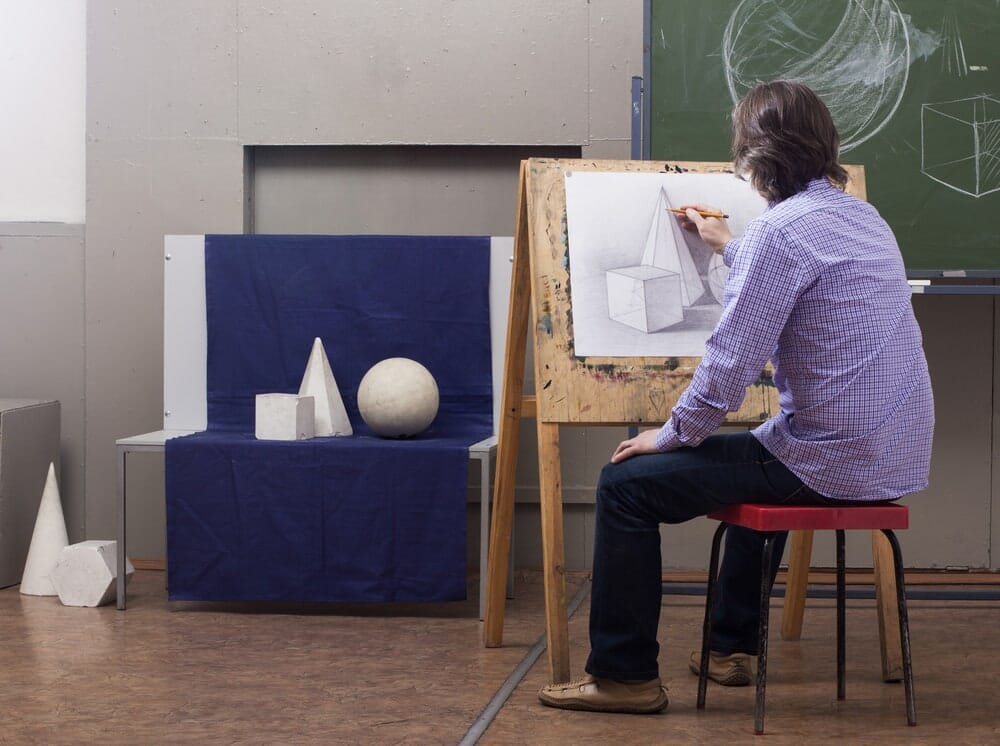
Representational work has enjoyed a bit of a come up dorsum in contempo years. Painters like Jenny Saville, Eric Fischl, and Kehinde Wiley have cracked the upper echelons of the gimmicky art market with unapologetically figurative paintings. Equally a consequence, art schools that champion figuartive work, like the New York University of Art, are enjoying their fourth dimension in the dominicus, while those that accept sneered at representation for decades are starting to reconsider.
Another factor that contributes to this changing opinion is the incoming faculty at art colleges. These days, due in no small part to the recent popularity of private studio schools, a larger percentage of newly hired faculty take a stronger groundwork in traditional techniques compared to their predecessors. These teachers thus have more to offer students seeking that kind of education in college.
These are reasons to be hopeful for students seeking both representational art instruction and a four-year fine art college experience.
Over to You lot
I'd dearest to hear your thoughts. Take yous ever attended an art higher? If so, what was your feel? Share in the comments below.
Source: https://vitruvianstudio.com/can-you-learn-to-draw-at-art-college/
0 Response to "Do I Need to Know How to Draw to Be an Art Professor"
Post a Comment