Roman God of Wisdom Poetry and Arts and Medicine
| Minerva | |
|---|---|
| Goddess of poetry, medicine, commerce, weaving, the crafts, wisdom, backbone, inspiration, victory, state of war, law, civilization, bravery, heroism, protection, metropolis country, family, justice, mathematics, science, engineering, strength, strategy, the arts, and skill | |
| Member of the Capitoline Triad and the Dii Consentes | |
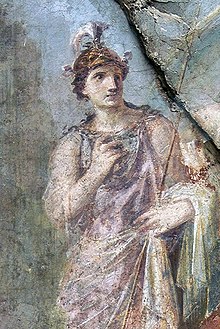 Fresco of Minerva from Herculaneum (1st century AD) | |
| Symbols | Owl of Minerva, olive tree, serpent of Jupiter, the Parthenon, the spear, the spindle, and Hellebore |
| Gender | Female |
| Parents | Jupiter Metis |
| Equivalents | |
| Greek equivalent | Athena |
| Etruscan equivalent | Menrva |
| Canaanite equivalent | Anat[i] |
| Egyptian equivalent | Neith |
| Celtic equivalent | Brigantia |

Minerva (Latin: [mɪˈnɛrwa]; Etruscan: Menrva) is the Roman goddess of wisdom, justice, law, victory, and the sponsor of arts, trade, and strategy. Minerva is not a patron of violence such as Mars, simply of defensive war but.[2] From the second century BC onward, the Romans equated her with the Greek goddess Athena.[3] Minerva is i of the 3 Roman deities in the Capitoline Triad, along with Jupiter and Juno.
She was the virgin goddess of music, poetry, medicine, wisdom, commerce, weaving, and the crafts.[4] She is ofttimes depicted with her sacred fauna, an owl usually named every bit the "owl of Minerva",[5] which symbolised her association with wisdom and knowledge too equally, less oft, the snake and the olive tree. Minerva is usually depicted every bit tall with an athletic and muscular build, as well as wearing armour and carrying a spear. As the most important Roman goddess, she is highly revered, honored, and respected.[6] Marcus Terentius Varro considered her to be ideas and the plan for the universe personified.[seven]
Etymology [edit]
The name Minerva stems from Proto-Italic *meneswo' ('intelligent, understanding'), and ultimately from Proto-Indo-European (PIE) *menos ('thought'). Helmut Rix (1981) and Gerhard Meiser (1998) accept proposed the PIE derivative *menes-ueh₂ ('provided with a mind, intelligent') equally the transitional course.[8]
Origin [edit]
Following the Greek myths around Athena, she was born of Metis, who had been swallowed by Jupiter, and burst from her male parent's head, fully armed and clad in armour.[9] Jupiter raped the titaness Metis, which resulted in her attempting to modify shape (or shapeshift) to escape him. Jupiter so recalled the prophecy that his own child would overthrow him as he had Saturn, and in turn, Saturn had Caelus.
Fearing that their child would be male person, and would abound stronger than he was and rule the Heavens in his identify, Jupiter swallowed Metis whole subsequently tricking her into turning herself into a fly. The Titaness gave birth to Minerva and forged weapons and armour for her kid while within Jupiter'due south body. In some versions of the story, Metis connected to alive within of Jupiter'south mind as the source of his wisdom. Others say she was but a vessel for the nascency of Minerva. The constant pounding and ringing left Jupiter with agonizing pain. To relieve the pain, Vulcan used a hammer to carve up Jupiter'due south head and, from the crack, Minerva emerged, whole, adult, and in full battle armour.
Presence in mythology [edit]
Minerva is a prominent figure in Roman mythology. She appears throughout many famous myths. Many of the stories of her Greek counterpart Athena are attributed to Minerva in Roman mythology, such as that of the naming of Athens[10] resulting from a competition between Minerva and Neptune,[11] in which Minerva created the olive tree.[ii]
Minerva and Arachne [edit]
Arachne was a mortal highly proficient in weaving and embroidery. Not merely were her finished works that were beautiful, but as well her process, so much so that nymphs would come out of their natural environments to watch her work. Arachne boasted that her skills could beat those of Minerva, and if she were incorrect she would pay the price for it. This angered Minerva, and she took the form of an old woman to approach Arachne, offer her a chance to take dorsum her challenge and inquire forgiveness.[xi] When Arachne refused, Minerva rid herself of her disguise and took Arachne up on her claiming. Arachne began to weave a tapestry which showed the shortcomings of the gods, while Minerva depicted her competition with Neptune and the gods looking down with disgust on mortals who would dare to challenge them.[eleven] Minerva's weaving was meant as a final alert to her foe to dorsum down. Minerva was insulted by the scenes which Arachne was weaving, and destroyed information technology. She and then touched Arachne on the forehead which fabricated her feel shame for what she had washed, leading her to hang herself. Minerva then felt bad for the woman, and brought her back to life. However, Minerva transformed her into a spider every bit punishment for her actions, and hanging from a web would forever be a reminder to Arachne of her actions which offended the gods. This story also acted as a warning to mortals not to challenge the gods.[2]
Minerva and Medusa [edit]
Medusa was once a cute man, a priestess of Minerva. Afterwards on, Minerva establish out that Neptune and Medusa were kissing in a temple dedicated to Minerva herself. Considering of this Minerva turned her into a monster, replacing her hair with hissing snakes and removing her charm. Medusa turned any living animal she looked upon into stone. When Perseus approached Medusa he used her reflection in his shield to avoid contact with her eyes, and then beheaded her.[10] He delivered the severed head to Minerva, who placed its image on her Aegis.[2]
Taming of Pegasus [edit]
When Perseus beheaded Medusa some of the blood spilled onto the footing, and from it came Pegasus. Minerva defenseless the horse and tamed it before gifting the horse to the Muses. It was a kicking from the hoof of Pegasus which opened the fountain Hippocrene.[11] When Bellerophon later went to fight the Chimera he sought to use Pegasus in the fight. In order to do this he slept in Minerva'southward temple, and she came to him with a gold bridle. When Pegasus saw Bellerophon with the bridle the horse immediately immune Bellerophon to mount, and they defeated the Chimera.[2]

Painting of Minerva visiting the Muses
Turning Aglauros to Stone [edit]
Metamorphoses past Ovid tell the story of Minerva and Aglauros. When Mercury comes to seduce mortal virgin Herse, her sister Aglauros is driven by her greed to assist him. Minerva discovers this and is furious with Aglauros. She seeks the assistance of Envy, who fills Aglauros with and so much envy for the proficient fortune of others that she turns to rock. Mercury fails to seduce Herse.[11]
Minerva and Hercules [edit]
Minerva assisted the hero Hercules. In Hyginus' Fabulae she is said to take helped him kill the Hydra (30.three).[10]
Minerva and Odysseus [edit]
Minerva assisted the hero Odysseus. Hyginus describes in his piece of work Fabulae that Minerva changes Odysseus' appearance in gild to protect and assist him multiple times (126).[10]
Inventing the Flute [edit]
Minerva is thought to have invented the flute past piercing holes into boxwood. She enjoyed the music, but became embarrassed by how it made her face look when her cheeks puffed out to play. Because of this she threw it away and information technology landed on a riverbank where it was plant past a satyr.[12]
Worship in Rome and Italy [edit]
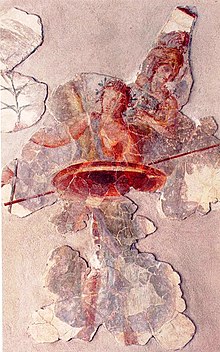
Fresco of Minerva (helmeted effigy on correct) from the Villa San Marco, Stabiae (1st century Advertisement)

Raised-relief image of Minerva on a Roman aureate silver basin, commencement century BC


Silver denarius of the Roman Emperor Domitianus (Domitian) featuring Minerva, dated c. 90 AD, IMP CAES DOMIT AVG GERM P Yard TR P VIIII, laureate head right; IMP XXI COS 15 CENS P P P, Minerva standing left, holding spear and thunderbolt, shield resting against dorsum of leg; References: BMC 167, RIC 691, RSC 260, Paris 159, Cohen 260
Minerva was worshipped at many locations in Rome, virtually prominently equally role of the Capitoline Triad. She was also worshipped at the Temple of Minerva Medica, and at the "Delubrum Minervae", a temple founded around 50 BC past Pompey on the site now occupied past the church of Santa Maria sopra Minerva.
The Romans historic her festival from March 19 to March 23 during the day which is chosen, in the neuter plural, Quinquatria, the fifth day after the Ides of March, the nineteenth, an artisans' holiday. This festival was of deepest importance to artists and craftsmen as she was the patron goddess of crafting and arts.[13] According to Ovid (Fasti 3.809) the festival was v days long, and the outset day was said to exist the ceremony of Minerva's birth, so no blood was to be shed. The following four days were full of games of "fatigued swords" in honour of Minerva'south armed forces clan.[xiv] Suetonius tells us (Life of Domitian iv.4) that Domitian celebrated the Quinquatria by appointing a college of priests who were to stage plays and creature games in improver to poetry and oratory competitions.[xv] A lesser version, the Minusculae Quinquatria, was held on the Ides of June, June 13, by the flute-players, as Minerva was thought to have invented the flute.[12] In 207 BC, a society of poets and actors was formed to meet and make votive offerings at the temple of Minerva on the Aventine Loma. Amongst others, its members included Livius Andronicus. The Aventine sanctuary of Minerva continued to be an important center of the arts for much of the middle Roman Democracy.
As Minerva Medica, she was the goddess of medicine and physicians. As Minerva Achaea, she was worshipped at Lucera in Apulia where votive gifts and artillery said to be those of Diomedes were preserved in her temple.[16] [17]
We know due to the Acta Arvalia that a moo-cow was sacrificed to Minerva on October 13 58 AD along with many other sacrifices to celebrate the anniversary of Nero coming to power. On January 3 81 Advertizement, as a office of the New year's day vows, two cows were sacrificed to Minerva (among many others) to secure the well-being of the emperor Titus, Domitian Caesar, Julia Augusta, and their children. On January iii 87 Advert there is again tape of a moo-cow being sacrificed to Minerva among the many sacrifices fabricated equally a function of the New year's day vows.[eighteen]
In Fasti III, Ovid called her the "goddess of a thousand works"[14] due to all of the things she was associated with. Minerva was worshipped throughout Italy, and when she eventually became equated with the Greek goddess Athena, she also became a goddess of boxing. Dissimilar Mars, god of war, she was sometimes portrayed with sword lowered, in sympathy for the recent dead, rather than raised in triumph and battle animalism. In Rome her bellicose nature was emphasized less than elsewhere.[19]
According to Livy's History of Rome (seven.3), the annual nail marking the year, a process where the praetor maximus drove a nail into to formally keep track of the current yr, happened in the temple of Minerva considering she was thought to have invented numbers.[20] [21]
There is archaeological testify to suggest that Minerva was worshipped not just in a formal civic fashion, but also past individuals on a more personal level.[21]
Roman coinage [edit]
Minerva is featured on the coinage of different Roman emperors. She often is represented on the contrary side of a coin belongings an owl and a spear amidst her attributes.[22]
Worship in Britain during Roman occupation [edit]
During the Roman occupation of Britain, it was mutual for carpenters to own tools ornamented with images of Minerva to invoke a greater corporeality of protection from the goddess of crafts. Some women would also have images of her on accessories such every bit hairpins or jewellery. She was even featured on some funerary fine art on coffins and signet rings.[23]
Bath [edit]
During Roman rule Minerva became equated with the Celtic goddess Sulis, to the degree where their names were used both together and interchangeably.[23] and was believed to preside over the healing hot springs located in Bath.[24] Though Minerva is not a water deity, her association with intellectual professions every bit Minerva Medica she could also be thought of every bit a healing goddess, the epigraphic evidence present makes it clear that this is how Minerva was thought of in Bath.[24]
Some of the archaeological evidence present in Bathroom leads scholars to believe that it was idea Minerva could provide full healing from things such as rheumatism via the hot springs if she was given full credit for the healing.[23]
The temple of Sulis Minerva was known for having a miraculous altar-burn which burned coal as opposed to the traditional woods.[23]
Carrawburgh [edit]
In that location is evidence of worship of Minerva Medica in Carrawburgh due to archaeological evidence such every bit a relief depicting her and Aesculapius.[24]
Chester [edit]
There is a shrine dedicated to Minerva in Edgar's Field built in the face of a quarry next to the River Dee.
Etruscan Menrva [edit]
Stemming from an Italic moon goddess *Meneswā ('She who measures'), the Etruscans adopted the inherited Onetime Latin proper name, *Menerwā , thereby calling her Menrva. It is presumed that her Roman name, Minerva, is based on this Etruscan mythology. Minerva was the goddess of wisdom, war, art, schools, justice and commerce. She was the Etruscan counterpart to Greek Athena. Like Athena, Minerva flare-up from the head of her male parent, Jupiter (Greek Zeus), who had devoured her mother (Metis) in an unsuccessful attempt to prevent her birth.
By a process of folk etymology, the Romans could have linked her foreign name to the root men- in Latin words such as mens meaning "mind", mayhap because ane of her aspects equally goddess pertained to the intellectual. The word mens is built from the Proto-Indo-European root *men- 'mind' (linked with retentiveness as in Greek Mnemosyne/μνημοσύνη and mnestis /μνῆστις: memory, remembrance, recollection, manush in Sanskrit pregnant mind).
The Etruscan Menrva was function of a holy triad with Tinia and Uni, equivalent to the Roman Capitoline Triad of Jupiter-Juno-Minerva.
Modernistic depictions and references of Minerva [edit]
Universities and educational establishments [edit]
As a patron goddess of wisdom, Minerva frequently features in statuary, as an prototype on seals, and in other forms at educational institutions. Listings of this can be found on Minerva in the emblems of educational establishments.
Societies and governments [edit]

- The Seal of California depicts the Goddess Minerva. Her birth fully-grown parallels California condign a state without starting time being a territory.[25]
- The U.S War machine Medal of Honor for the Ground forces, Navy/Marine Corps, and Declension Guard depicts Minerva in the middle of information technology. The Air Force uses the caput of the Statue of Freedom instead. [26]
- According to John Robison's Proofs of a Conspiracy (1798), the third caste of the Bavarian Illuminati was called Minerval or Brother of Minerva, in honor of the goddess of learning. Later, this title was adopted for the first initiation of Aleister Crowley's OTO rituals.
- Minerva Schools at KGI is a global four-year undergraduate program.
- Minerva Hospital for Women and Children is a outset-class hospital in Chengdu, Cathay.
- The Max Planck Society, clan of research institutes mainly in Germany.
- Minerva Tutors is a leading private tuition and homeschooling bureau, based in London, UK.
- Minerva appears in the logo of Federal University of Rio de Janeiro and other educational institutions in Brazil.
Public monuments, and places [edit]

- A statue of Minerva is the heart of the Pioneer Monument in San Francisco's Civic Eye created by Frank Happersberger in 1894.
- A small Roman shrine to Minerva stands in Handbridge, Chester. It sits in a public park, overlooking the River Dee.
- An imposing bronze statue of Minerva stands on the rooftop of the Círculo de Bellas Artes, Madrid, Espana.[27]
- A statue to Minerva was designed by John Charles Felix Rossi to adorn the Town Hall of Liverpool, where it has stood since 1799. It remains extant and was restored as part of the 2014 renovations conducted by the city.[28] [29]
- The Minerva Roundabout in Guadalajara, Mexico, located at the crossing of the López Mateos, Vallarta, López Cotilla, Agustín Yáñez, and Golfo de Cortez avenues, features the goddess continuing on a pedestal, surrounded by a big fountain, with an inscription that says "Justice, wisdom and forcefulness guard this loyal metropolis".
- A bronze statue of Minerva stands in Monument Square (Portland, Maine). "Our Lady of Victories Monument" defended in 1891, features a fourteen-feet-tall bronze figure past Franklin Simmons atop a granite pedestal with smaller bronze sculptures past Richard Morris Hunt.[30] [31]
- A sculpture of Minerva by Andy Scott, known every bit the Briggate Minerva, stands exterior Trinity Leeds shopping centre.
- Minerva is displayed every bit a statue in Pavia, Italy, nearly the train station, and is considered equally an important landmark in the city.
- Minerva is displayed equally a cast bronze statue in the Minneapolis Central Library, rendered in 1889 by Jakob Fjelde.[32]
- Minerva is displayed as a bronze statue in Frederick Ruckstull'due south 1920 Altar to Liberty: Minerva monument nigh the acme of Battle Hill, the highest signal of Brooklyn, New York, in Green-Wood Cemetery.
- Minerva is displayed equally an 11-ft statue in Jean-Antonin Carlès'south 1895 "James Gordon Bennett Memorial" in New York City's Herald Foursquare.[33]
- A statue of Minerva is displayed at Wells Higher outside of Main Building. Each year, the senior class decorates Minerva at the beginning of the fall semester. Minerva remains decorated throughout the school year; so during the morning time of the final day of classes and later on singing around the Sycamore tree, the senior class takes turns kissing the anxiety of Minerva, believed to be good luck and bring success and prosperity to all graduation seniors.[34] [35] [36]
- A statue of Minerva stands atop the Ballaarat Mechanics' Constitute in Ballarat, Victoria, Australia. In that location is also a mosaic tile of Minerva in the foyer of the edifice as well as a whole theatre proper name after her, called the 'Minerva Space'.[37]
- A bronze statue of Minerva stands on the campus of The University of North Carolina at Greensboro, Greensboro, North Carolina. It was commissioned in 2003 by the Form of 1953 and created by sculptor James Barnhill.

Literature [edit]
She is remembered in De Mulieribus Claris, a collection of biographies of historical and mythological women by the Florentine author Giovanni Boccaccio, composed in 1361–62. It is notable every bit the first collection devoted exclusively to biographies of women in Western literature.[38] Poet Elizabeth Carter is famously portrayed in an outfit inspired past Minerva, and also wrote poems in her accolade.
Popular Culture [edit]
- Minerva is 1 of the members of the featured pantheon in comic series The Wicked + The Divine.
- Minerva is a character from Crunch Core: Final Fantasy Seven.
- A not-speaking Athena/Minerva character is present throughout Disney's Hercules.
- In BioShock 2, the addition Minerva'south Den takes place in a commune of the underwater metropolis of Rapture of the aforementioned proper noun, that is a hub of loftier engineering.
- In the Harry Potter serial Professor McGonagall first name is Minerva, and the character'south chief traits are equivalent to the Roman goddess.
- Minerva is a song by Deftones, from their album Deftones.
- Minerva appears in Rick Riordan'southward The Mark of Athena where protagonist Annabeth Hunt, the girl of Minerva's Greek attribute Athena, meets the goddess in Yard Central Station. Minerva gives Annabeth a magical money, the Mark of Athena, and then that she tin can locate the Athena Parthenos. Still, due to an argument that they have, Minerva revokes the magical backdrop of Annabeth's Yankees cap in penalty which Annabeth doesn't get back until The Staff of Serapis.
- Minerva is the name of the firm that main protagonist Stevie Bell lives in at Ellingham Academy in the Truly Stray volume series written by Maureen Johnson.
References [edit]
- ^ L. Day 1999, p. 39. sfn error: no target: CITEREFL._Day1999 (help)
- ^ a b c d due east Bulfinch, Thomas. (2010). The Historic period of Fable, or Stories of Gods and Heroes. Neeland Media LLC. ISBN978-1-59625-257-viii. OCLC 1028955021.
- ^ Larousse Desk Reference Encyclopedia, Volume People, Haydock, 1995, p. 215.
- ^ Candau, Francisco J. Cevallos (1994). Coded Encounters: Writing, Gender, and Ethnicity in Colonial Latin America. Academy of Massachusetts Press. p. 215. ISBN0-87023-886-eight.
- ^ Philosophy of Correct (1820), "Preface"
- ^ Fara, Patricia (2010-03-01). "Minerva/Athene". Endeavour. 34 (1): 4–5. doi:x.1016/j.try.2010.01.001. ISSN 0160-9327. PMID 20096932.
- ^ Augustine, of Hippo, Saint, 354-430. (2008) [1950]. The city of God. Catholic University of America Press. ISBN978-0-8132-1108-4. OCLC 647919892.
{{cite volume}}: CS1 maint: multiple names: authors listing (link) - ^ de Vaan 2008, pp. 380–381.
- ^ Encarta World English language Dictionary 1998–2004 Microsoft Corporation.
- ^ a b c d Apollodorus; Hyginus (2007). Apollodorus' Library and Hyginus' Fabulae: Two Handbooks of Greek Mythology. Hackett Pub. ISBN978-0-87220-820-9.
- ^ a b c d e Ovid, 43 B.C.–17 A.D. or 18 A.D. (2018). Metamorphoses. ISBN978-0-253-03359-8. OCLC 1007036859.
- ^ a b "OVID, FASTI BOOK 6 - Theoi Classical Texts Library". www.theoi.com . Retrieved 2020-03-31 .
- ^ Lurker, Manfred (2004-08-02). The Routledge Dictionary of Gods and Goddesses, Devils and Demons. doi:x.4324/9780203643518. ISBN9780203643518.
- ^ a b "OVID, FASTI Volume 3 - Theoi Classical Texts Library". www.theoi.com . Retrieved 2020-03-31 .
- ^ "Suetonius, Life of Domitian iv". lexundria.com . Retrieved 2020-03-31 .
- ^ Aristotle Mirab. Narrat. 117
- ^ Schmitz, Leonhard (1867). "Achaea (2)". In Smith, William (ed.). Dictionary of Greek and Roman Biography and Mythology. Vol. i. Boston. p. 8.
- ^ Gradel, Ittai (2002). Emperor worship and Roman religion. New York: Clarendon Press.
- ^ Mark Cartwright. "Minerva". Globe History Encyclopedia.
- ^
- ^ a b MacRae, Duncan (2016). Legible organized religion : books, gods, and rituals in Roman civilisation. Harvard University Press. ISBN978-0-674-08871-nine. OCLC 974037540.
- ^ "American Numismatic Society: Browse Collection". Retrieved 2017-03-02 .
- ^ a b c d Henig, Martin (1984). Religion in Roman United kingdom of great britain and northern ireland. London: Batsford.
- ^ a b c Sauer, Eberhard (March 1996). "An Inscription from Northern Italy, the Roman Temple Complex in Bathroom and Minerva as a Healing Goddess in Gallo-Roman Religion". Oxford Periodical of Archaeology. 15: 63–93. doi:10.1111/j.1468-0092.1996.tb00074.x.
- ^ "California State Symbols". California Land Library.
- ^ "Three Medals of Award". National Medal of Accolade Museum. 16 July 2018.
- ^ Carriazo, Inés; Vasco Campos, Aurora (July 2017). "Visita a las azoteas de Madrid: cuando los tejados se convierten en las mejores terrazas". El Confidencial.
- ^ Cavanagh, Terry (1997). Public sculpture of Liverpool. Liverpool University Press. pp. lxx–ane. ISBN9780853237112.
- ^ Elson, Peter (2014-10-fourteen). "Liverpool Town Hall'southward Minerva statue restored to heavenly status". Liverpool Echo.
- ^ "Our Lady of Victories (The Portland Sailors and Soldiers Monument)". Public Fine art Portland . Retrieved 28 Jan 2017.
- ^ "Maine Ceremonious War Monuments: Portland (Monument Square)". Maine.gov. Archived from the original on 2015-05-24. Retrieved 28 January 2017.
- ^ "Minerva". Hennepin County Library.
- ^ "Herald Foursquare Monuments - James Gordon Bennett Memorial : NYC Parks". world wide web.nycgovparks.org.
- ^ "minerva | Search Results | Wellsipedia". wellsipedia.wordpress.com . Retrieved 2017-03-09 .
- ^ Citizen, Erik Sorensen / Special to The. "Wells College to graduate its first males this weekend". Auburn Denizen . Retrieved 2017-03-09 .
- ^ York, Michelle (2005-09-06). "Wells Higher: Newly, and Uneasily, Coed". The New York Times. ISSN 0362-4331. Retrieved 2017-03-09 .
- ^ "Ballaarat Mechanics' Institute - All are welcome to visit for tours, cultural events and exhibitions". Ballarat Mechanics Institute . Retrieved 2019-03-09 .
- ^ Boccaccio, Giovanni (2003). Famous Women. I Tatti Renaissance Library. Vol. 1. Translated past Virginia Brownish. Cambridge, MA: Harvard University Printing. p. eleven. ISBN0-674-01130-nine.
Bibliography [edit]
- de Vaan, Michiel (2008). Etymological Lexicon of Latin and the other Italic Languages. Brill. ISBN9789004167971.
-
 This commodity incorporates text from a publication now in the public domain:Smith, William, ed. (1870). Dictionary of Greek and Roman Biography and Mythology. See page 1090
External links [edit]
- Roman Mythology
 | Wikimedia Eatables has media related to Minerva. |
Source: https://en.wikipedia.org/wiki/Minerva
0 Response to "Roman God of Wisdom Poetry and Arts and Medicine"
Post a Comment